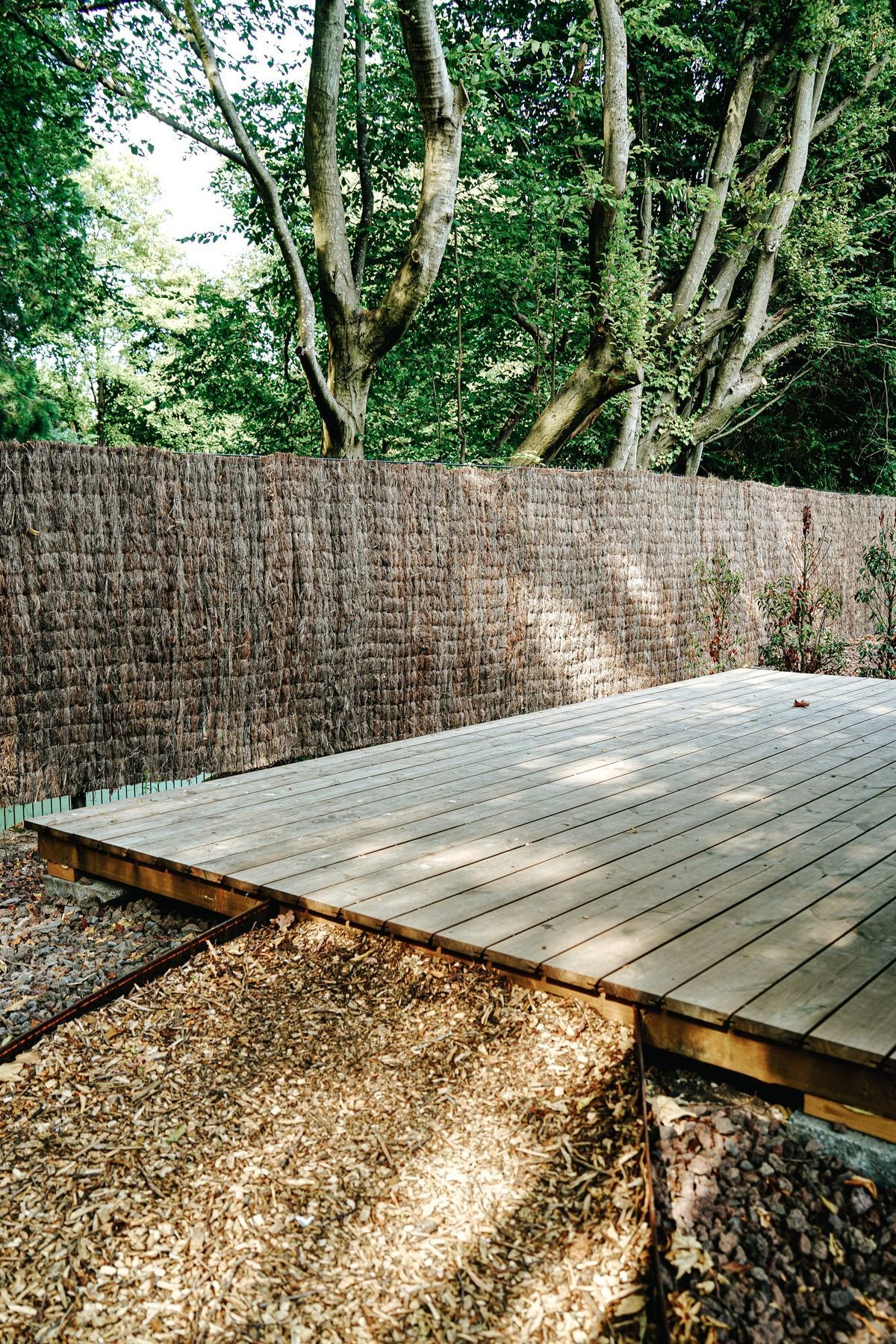
Decks here live outside twelve months a year. Pollen sticks in spring. Afternoon thunderstorms keep the boards damp. By August the gaps grow a green line, and the handrail feels slick. Fences, especially white vinyl on a shaded lot line, do the same thing in vertical.
Controlled-Pressure Wood & Vinyl Cleaning
Wood fibers stand up when a high-pressure tip hits them. That fuzz is what people call “raised grain,” and it is miserable to walk on and worse to stain over. The fix is not a second pass at higher pressure. The fix is never raising the grain: a wider fan, more distance, lower PSI, and a wood cleaner or a mild sodium hypochlorite mix where the growth is organic.
Vinyl does not splinter. It does stripe, and it does warp if a hot tip is held in one place. A white privacy fence wants an even application and a rinse before the sun bakes the chemical into a drip line.
We are cleaning. We are not replacing boards, resetting posts, or staining. If the deck is soft underfoot, washing will not make it structural again. Say so in the quote notes and we will tell you if the surface is still worth cleaning.
Materials We Clean
Pressure-Treated Pine & Cedar Decks
Pine is the common backyard deck. Cedar shows up on older porches and some screened rooms. Both go gray as ultraviolet light breaks down the surface lignin. A wash removes the gray layer that is loose, the mildew, and the pollen. It does not restore a board that has cupped into a bowl. We work with the grain, keep the tip moving, and treat rail spindles one by one so the jets are not fired through them into the siding.
Composite Decking
Capped composite and PVC boards shrug off a stain schedule and still hold a biofilm. Manufacturers publish a wash method, usually a soft brush and a mild cleaner, sometimes a low-pressure rinse. We follow that sheet. A surface cleaner set up for concrete is the wrong tool. It can dull the cap.
White Vinyl Privacy Fences
Algae on vinyl is the same organism family as the green on the north wall of the house. It comes off with a soft-wash mix and a rinse. Ground splash throws red clay onto the bottom rail. Clay needs the clay detergent, not more bleach. We protect the shrubs on the neighbor’s side of the fence the same way we protect yours: pre-wet, then rinse.
Wood Picket & Shadowbox Fences
Older picket fences are often cedar or pine with failing stain. Washing shows the bare wood. That is useful if you are about to refinish, and it is disappointing if you hoped the wash would look like stain. We set that expectation in the quote. Loose pickets get noted. We do not nail them back as part of a wash.
Prepping Wood for Stain or Sealer
If a painter or a deck finisher is coming behind us, the wash has to leave the wood clean and open, not glazed with soap. We use a cleaner that rinses, not a wax. Afterward the boards need to dry to the moisture content the stain maker wants. In Dothan in July, a deck in full sun might be ready in two days. A deck under a water oak might take most of a week. The wood deck article covers fan tips and the dry-down in more detail.
Do not put a sealer on a deck that still feels cool and damp in the shade. It will peel, and the next person will blame the wash.
Horizontal surfaces around the pool are a different scope. Wood deck boards and a masonry pool surround should not be priced or washed as if they were the same material.
Deck & Fence Cleaning FAQ
Size is length times width for a deck, and linear feet plus height for a fence. A typical small deck or a single fence run is often in a planning range of about $150–$400. That is a typical range, estimate only. Two-story decks, heavy gray wood that needs a brightener, and clay along the bottom of a long vinyl run cost more. Ask on the quote form and include whether the wood is scheduled for stain.